


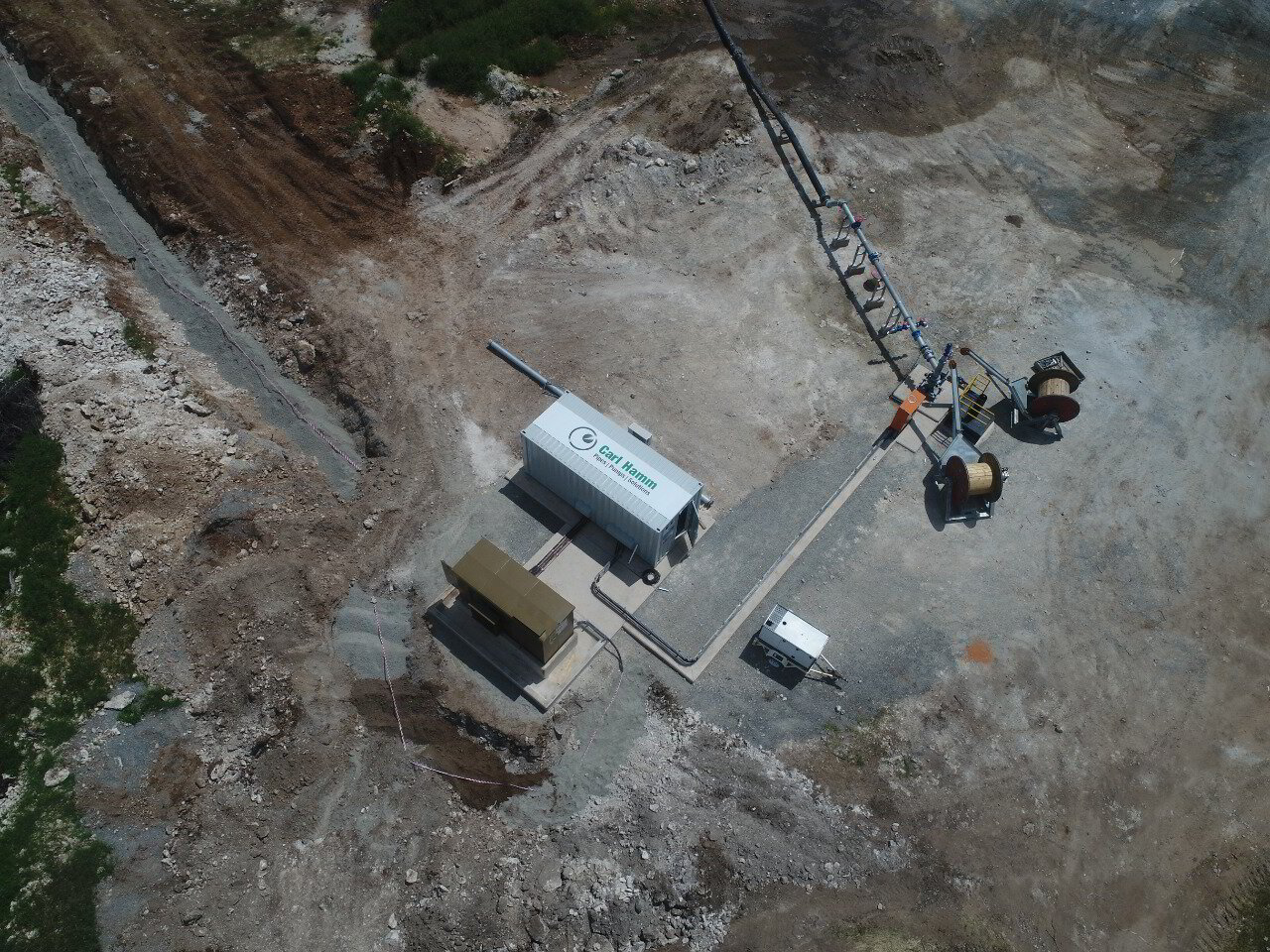
When lowering riser pipes to fix all cables to the column, the installation team must lift all the cables above head level and pull the slack to ensure that there are no bends or loops in the cable below that may cause obstructions in the borehole. The cables must be lifted high enough to clamp the cables to the column. Manual handling of these cables for extended periods is associated with various risks – Carl Hamm’s specially designed cable dispensers mitigate these risks. This Power Cable dispenser is designed to cater for trailing power supply cable to the submerged motor. The Dispenser is manually driven forward and reversed via a handwheel mounted to a gearbox. The counterweights are designed for the application.
PREPARATION & PLACEMENT OF THE CABLE DRUM
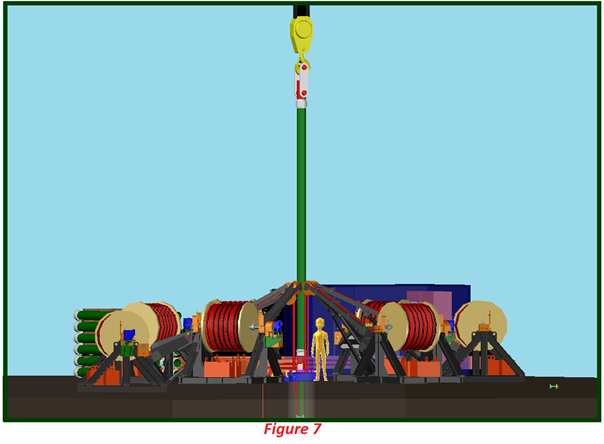
All cable dispensers are placed close to the borehole, and the extension boom is positioned next to the riser pipe to allow for smooth installation. This allows the cable to be right above the borehole in its correct position, allowing for the full load of each cable to be properly supported. The extension boom should be high enough to allow enough workspace around the bore hole. The shaft is placed through the center hole of each cable drum and a reel locking cone will secure and lock the cable drum in the center of the shaft. Each shaft is certified and signed off to carry the load of these cable drums by a PR Engineer. The cable dispenser is designed to take the full load of the cable which will require one operator at the gearbox end. The Main Frame is positioned and placed on a level surface, the cable drum and shaft are then lifted with an overhead crane and placed on the roller brackets which is fixed to the main frame of the cable dispenser. The lid of the roller bracket will be closed and fastened with a locking pin to ensure the shaft cannot be removed while in operation. The trestles are certified to handle these loads.
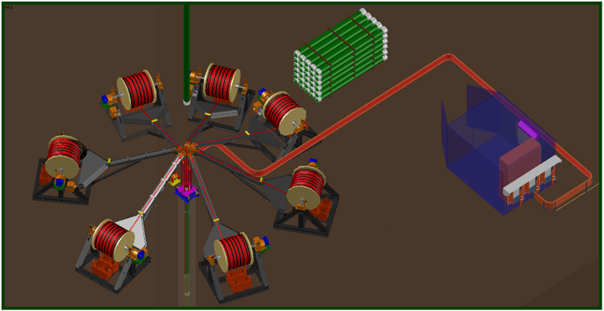
OPERATION OF THE CABLE DISPENSER
Once the cable dispensers are positioned correctly and the cable is guided through the extension boom over the sheave wheel, the control of the cable lowering will be handled by the person operating the manual turning of the handwheel. The operator will have full control over lowering or lifting of each cable. The tension on the cables can be controlled by the manually hand operated gearbox, which can be lowered if the tension is too high and lifted if there is too much slack on the cable. Cable slack can be automatically created or removed by going forward or backwards with the gearbox.
MITIGATED RISKS
Manual handling of these heavy cables for too long can lead to back strain and injury – as for manual installation teams to be able to submerge cables vertically, cables must run over their shoulders, which is physically taxing – our cable dispensers eliminate the risk of injury to personnel from handling these cables, while also ensuring timeous completion of projects by eliminating downtime for rest periods, and also reducing labour costs by up to 50% by minimising manpower needed to handle cable drums. Major damage to electrical motors can occur from cables being dragged on gravel conditions – the cable dispenser removes the need for dragging of cables, thus eliminating the risk of potential damage. The multiple personnel members needed to handle cables manually can cause overcrowding around the borehole, creating tripping hazards and leaving minimal space to move around in the case of an emergency – our cable dispensers require only two personnel members to guide and clamp the cables to the riser pipe columns as they are lowered. The cable dispensers allow the installation team to have full control over the handling of the cables, which they then can guide to the correct fixing point on the riser pipe columns. The risk of excess cable slack is eliminated as tension on the cables is controlled by a manually hand operated gearbox. Maintenance teams will not have to handle heavy cables while monitoring the safety of the pumps going down the borehole. Because the trestle is positioned on a level surface and the cable drum is well secured and locked into position, the risk of the cable drum falling is eliminated, thus also mitigating the risk of injury to personnel as well as potential damage to the cable itself. The uninstalling of pipes and pumps is more efficient now that cables are more easily rolled.

We are more than willing to assist in training on how to set up the cable dispensers in their correct positions and assist with the operation of these devices
Learn more at carl-hamm.co.za
ADVERTISEMENT